Exercise therapy and strength rehab in Toronto and Whitby
Graded loading programs built around your sport, your gym or your day, and progressed at every visit.
Overview
Most of what I treat responds to graded loading rather than rest: tendon problems, most back pain, and nearly all post-operative rehabilitation.
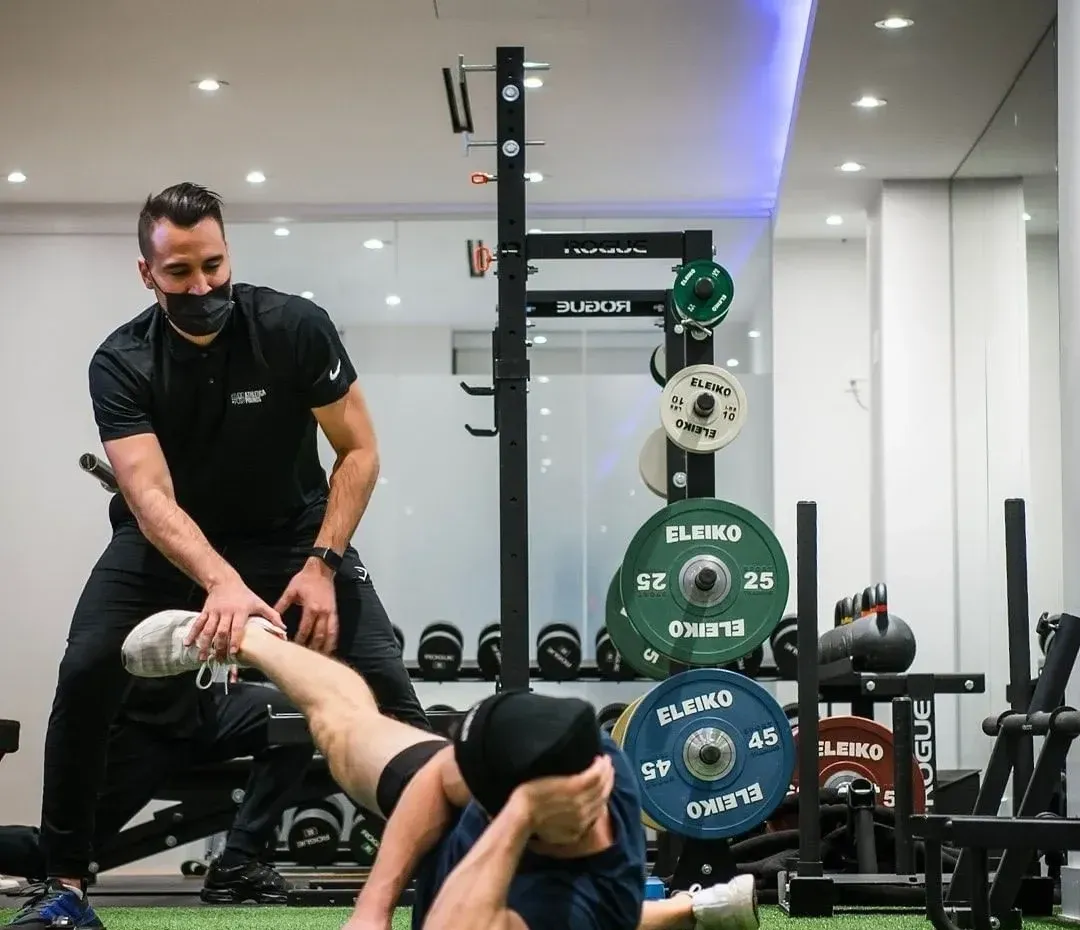
You leave every session with a written program, and we progress it at each visit as your capacity improves. Where it helps, sessions happen on the gym floor rather than on a treatment table.
What is exercise therapy?
Exercise therapy is a program of specific exercises, chosen for your problem and dosed for your current capacity, then progressed as you get stronger. It can be as simple as a few movements at home or as involved as a full strength session on the gym floor.
How does exercise therapy work?
Tendons, muscles, bones and joints adapt to the loads placed on them. When load is increased gradually, they become stronger and more tolerant. Exercise also calms a sensitized nervous system, so movements that hurt become comfortable again, and it rebuilds confidence in a part of the body you may have been protecting.
How I use exercise therapy in treatment
Exercise is the backbone of almost every plan I write. Hands-on treatment and other techniques can ease pain in the short term, but the long-term change comes from what you do between visits. The program you go home with is the treatment.
Every exercise has a reason, a dose (sets, repetitions, load and speed) and a clear rule for when to progress it. I would rather give you four exercises done well than twelve done half-heartedly.
What happens in a session?
We test what you can currently do, choose the exercises that target the problem, and practise them together so you know how they should feel. You leave with a written program, and at each visit we review how your body responded and progress it.
Who can exercise therapy help?
Tendon problems, most back and neck pain, recovery after surgery, sports injuries, running injuries and anyone getting back to the gym after time off.
Is exercise therapy safe, and what should I expect afterwards?
Some muscle soreness a day or two after a new or harder session is normal. Mild discomfort during an exercise can be acceptable within limits we agree on; pain that is worse the next day means the dose needs adjusting, and we adjust it.
Every plan starts with a full assessment, so the treatment fits what is actually driving your problem. Exercise therapy and strength rehabilitation is one tool within that plan, not the whole plan.
Conditions I use it for
- Achilles tendinopathy
- Tennis elbow (lateral epicondylalgia)
- Vertigo and BPPV
- Plantar heel pain
- Runner's knee (patellofemoral pain)
- Rotator cuff and shoulder pain
- Low back pain
- TMJ and jaw pain
- Hip impingement (FAI)
- The Epley manoeuvre
- Neck pain and stiffness
- Headaches arising from the neck
- Bone stress injury in runners
- Sciatica
- Ankle sprain
- Frozen shoulder (adhesive capsulitis)
- Knee osteoarthritis
- Hamstring strain
- Shin splints (medial tibial stress syndrome)
- Gluteal tendinopathy (hip bursitis)
- Whiplash
- Pinched nerve in the neck (cervical radiculopathy)
- Herniated or bulging disc
- Lumbar spinal stenosis
- Golfer’s elbow (medial epicondylalgia)
- Carpal tunnel syndrome
- De Quervain’s tenosynovitis
- Hip osteoarthritis
- Patellar tendinopathy (jumper’s knee)
- IT band syndrome
- Meniscus tear
- MCL sprain
- Osgood-Schlatter disease
- Sever’s disease (heel pain in children)
- Morton’s neuroma
- Calf strain (tennis leg)
- Groin pain and adductor strains
- Calcific shoulder tendinitis
- Tension-type headache
- Wry neck (acute stiff neck)
- Desk and posture-related pain
- Piriformis syndrome (deep gluteal pain)
- Scoliosis-related back pain
- Shoulder dislocation (instability)
- AC joint sprain (separated shoulder)
- Elbow bursitis (olecranon bursitis)
- Hip labral tear
- High hamstring tendinopathy
- Knee bursitis and Baker’s cyst
Related programs of care
- ACL injury and reconstruction program
- Post-operative rehabilitation program
- Persistent tendon pain program
- Running injury and return-to-run program
- Athlete return-to-sport program
Where I practise
- Athlete's Care Yonge & Eglinton: Mon/Wed/Fri, 8:00 AM – 2:00 PM
- Athlete's Care Whitby Whitby: Mon/Wed/Fri, 3:00 PM – 6:30 PM
- Push Pounds Downtown Toronto: Tue/Thu, 8:30 AM – 6:30 PM
- Country Lane Home office & virtual: Mon/Wed evenings in person or virtual · Sat mornings virtual
Booking for a specific treatment? Mention it when you book so we can confirm which location suits it.
Before you book
Do I need a doctor’s referral to see a physiotherapist in Ontario?
No. In Ontario you can book directly with a registered physiotherapist, no referral needed. Some extended health plans, and motor vehicle or workplace injury claims, have their own requirements, so it is worth checking your plan before your first visit.
Is physiotherapy covered by OHIP?
OHIP only covers physiotherapy for certain eligible groups at OHIP-funded clinics. Appointments with me are private, not billed to OHIP. Most extended health benefit plans cover registered physiotherapy, and you receive a receipt after every visit to submit to your plan.
Can my appointment be billed directly to my insurance?
Direct billing depends on the clinic and on your insurer. Ask when you book and the clinic will confirm whether they can bill your plan directly.
Other physiotherapy services
- Contemporary medical acupuncture and electroacupuncture
- Dry needling
- Joint mobilization and spinal manipulation
- Trigger point and soft tissue release
- IASTM soft tissue release
- Static and dynamic silicone cupping
- Shockwave therapy
- Functional Movement Screen (FMS)
- Movement and running gait assessment
- Virtual and in-home physiotherapy
Book an appointment
Start with a proper assessment
A full history, a physical examination and a written plan you leave with. Book online at the clinic nearest you, send me a message, or call me directly.